
Security by Design
Moving Beyond Buzzwords to Business Predictability

In the boardrooms of critical infrastructure companies, “Security by Design” is often treated as a buzzword—a slogan mandated by CISA or a slide in a deck to appease regulators.
But for those of us operating in high-stakes environments—whether it’s medical devices, energy grids, or financial platforms—we know the truth: Security by Design is an economic imperative.
It isn’t just about “shifting left” or “DevSecOps.” It is about capital efficiency.
In traditional development, security is a tax paid at the end of the project—a “final gate” that delays launches and triggers expensive rework. In a modern, business-driven model, Security by Design is the mechanism that ensures predictability.
Here is how to move this concept from a slogan to a high-performance operating model that protects your margins as much as your customers.
The Economic Reality: The “Rework” Trap
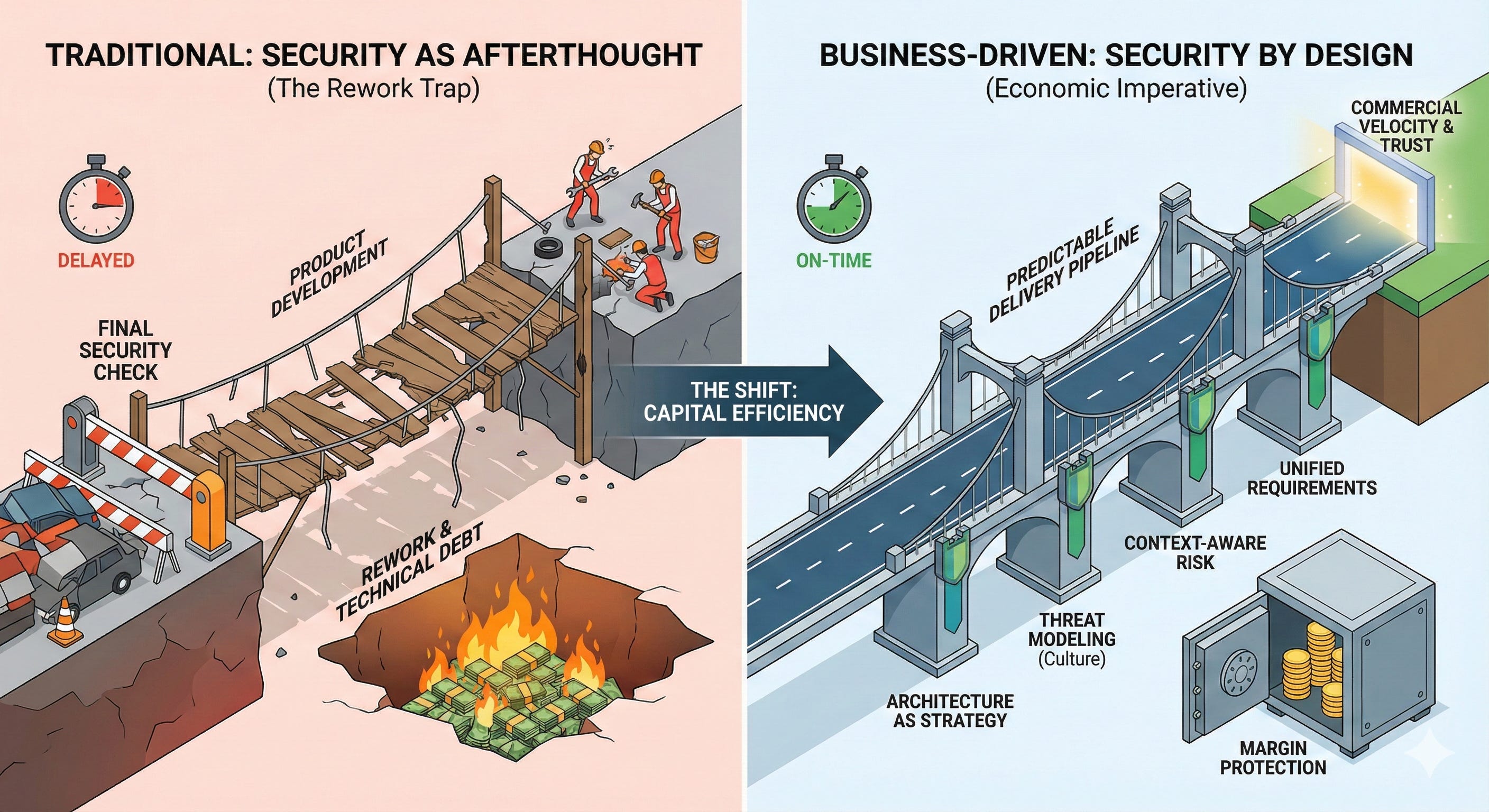
The old model of product development treated security as a compliance hurdle to clear before release. This approach is functionally obsolete because it creates a massive hidden liability: Technical Debt on Steroids.
When you discover a fundamental security flaw during a late-stage penetration test, you aren’t just fixing a bug. You are tearing apart architecture. You are delaying revenue. You are burning engineering hours on rework instead of innovation.
I have seen products delayed by months because a security requirement was missed in the definition phase. That isn’t a “security failure”; that is a failure of business planning.
A Framework for Predictable Delivery
Over years of securing critical systems, I’ve refined a framework that stops the bleeding. It moves security from a “cleanup crew” to a “design partner.”
1. Architecture as Strategy (Stop Guessing)
Security cannot begin at the code level. It must begin at the concept level.
In my most successful implementations, we stopped letting security teams “review” finished designs and started embedding them in the Vision Phase.
The Shift: Every Product Requirements Document (PRD) must have a “Security & Trust” section—not as a wishlist, but as a constraint.
The Result: We reduced late-stage blocking issues by over 60%. By defining authentication, encryption, and data residency before a line of code was written, we turned security into a known quantity rather than a late-stage surprise.
2. Threat Modeling as Culture (The Stress Reliever)
The most transformative practice isn’t buying a new scanning tool; it’s collaborative threat modeling.
Too many leaders treat threat modeling as a dark art performed by security wizards in a back room. This is a mistake. When you bring engineers and security architects together to whiteboard “how would we break this?”, something magical happens: Shared Ownership.
The Shift: Engineers stop viewing security as “someone else’s job” and start building defensive code naturally.
The Result: For me as a leader, this is the ultimate stress reliever. It decentralizes risk management. You aren’t the police officer anymore; you are the architect helping the builder ensure the house won’t collapse.
3. Context-Aware Risk Assessment (One Size Fits None)
A generic risk model is useless in critical infrastructure. A vulnerability that matters to a consumer mobile app is irrelevant to an insulin pump, and vice versa.
The Shift: Stop using generic CVSS scores as your only metric. Implement Context-Aware Risk Assessments.
The Result: In MedTech, we prioritize patient safety above all else. In FinTech, we prioritize fraud logic. By tailoring the risk model to the specific business vertical, you give engineering teams a clear, defensible “Why.” You stop wasting time fixing low-value theoretical bugs and focus purely on the risks that threaten the business.
4. Unified Requirements (Feasibility Over Theory)
The friction between security and engineering usually comes from “impossible requirements”—security policies that break the user experience or kill system performance.
The Shift: Co-develop the security requirements with the engineering leads.
The Result: This ensures Technical Feasibility. When security requirements are treated as standard product features—prioritized and scoped alongside “new buttons” or “faster load times”—they get built correctly the first time.
The Business Outcomes
When you execute Security by Design correctly, you stop talking about “safe” and start talking about efficient.
Release Predictability: You eliminate the “security bottleneck” that kills launch dates. You know exactly what needs to be built, and you build it once.
Margin Protection: You stop burning cash on post-release patches, field actions, and emergency recalls.
Commercial Velocity: You align naturally with regulations like the FDA’s pre-market guidance or the EU Cyber Resilience Act. Compliance becomes a byproduct of good engineering, not a fire drill.
Making It Work
You don’t need to overhaul your entire engineering culture overnight. Start with the high-risk product lines. Insert a security architect into the design review of your next major feature.
The goal is not to be perfect instantly. The goal is to stop treating security as an afterthought and start treating it as a foundational component of product quality.
In the world of critical infrastructure, we don’t just build software. We build trust. And trust is designed, not patched.